
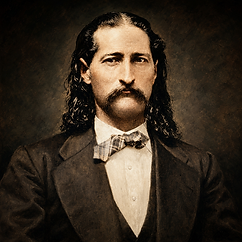
James Butler “Wild Bill” Hickok: Poker Hall of Famer and Dead Man’s Hand Legend

POKER HALL OF FAME
Inducted 1979
James Butler “Wild Bill” Hickok remains one of the most unusual members of the Poker Hall of Fame. He lived nearly a century before the modern tournament era, never competed for a World Series of Poker bracelet and left behind no verifiable record of tournament earnings. Yet his reputation as a gambler and his death during a poker game in Deadwood made him one of the most enduring historical figures associated with the game.
Born in Illinois in 1837, Hickok became nationally known as a frontiersman, lawman, army scout, marksman and gambler. His life became intertwined with the mythology of the American West, but poker players know him primarily for the hand he was reportedly holding when he was killed in 1876: two black aces and two black eights, later immortalized as the Dead Man’s Hand.
More than a century after his death, Hickok was included in the inaugural class of the Poker Hall of Fame in 1979. His induction recognized a poker legacy built not on tournament statistics, but on his place in American gambling history and the lasting cultural connection between his name and the game.
⠀
Who Was James Butler “Wild Bill” Hickok?
James Butler Hickok was born May 27, 1837, in Troy Grove, Illinois. The Library of Congress describes him as a frontiersman, lawman, army scout, gambler and legendary marksman.
Hickok moved west as a young man and became involved in the turbulent life of the frontier. Over the following years he worked in several roles, including wagon master, scout, guide, peace officer and deputy U.S. marshal.
His reputation expanded well beyond the places where he actually lived and worked. Accounts of his exploits appeared in national publications during his lifetime, helping turn Hickok into one of the best-known personalities associated with the American West.
The historical record is more complicated than the legend that developed around him. Some stories about Hickok were exaggerated or embellished as his fame grew. For a poker profile, the most important distinction is that gambling and playing cards were genuine parts of his life rather than details added only after his death.
⠀
Wild Bill Hickok’s Career as a Lawman and Gambler
Hickok spent significant portions of his career in Kansas. According to the Kansas Historical Society, he served as marshal of Hays and later as town marshal of Abilene.
The Kansas Historical Society also notes that Hickok developed a reputation for spending much of his time playing cards in saloons. Gambling therefore formed part of his public identity during the same period in which he became famous as a lawman and gunfighter.
That combination helps explain why Hickok occupies such an unusual place in poker history. He was not a tournament professional in any modern sense. Poker in the 19th-century frontier West was played in saloons, gambling houses and private games rather than organized casino series with documented buy-ins, prize pools and results.
There were no official player databases, bracelet counts or lifetime earnings records. For that reason, claims about Hickok’s poker winnings, win rate or specific accomplishments at the tables cannot be reliably quantified.
⠀
Was Wild Bill Hickok a Professional Poker Player?
Calling Hickok a professional poker player in the modern sense would be misleading.
Reliable historical sources identify him as a gambler and frequent card player, and official Deadwood historical material describes him as a professional gambler. Poker was clearly an important part of his life, but his career predates organized professional tournament poker by generations.
There is no reliable record showing how much money Hickok won or lost at poker during his lifetime. There are also no documented major titles comparable with those used to evaluate players today.
His significance comes instead from the role gambling played in his life and from the extraordinary cultural legacy created by his final poker game.
⠀
Wild Bill Hickok in Deadwood
Hickok arrived in Deadwood in the Dakota Territory in 1876, during the Black Hills gold rush.
Deadwood was growing rapidly as miners, merchants, gamblers and other fortune seekers moved into the area. Hickok joined that influx and spent only a short period in the settlement before his death.
On August 2, 1876, he entered Nuttal & Mann’s Saloon and took part in a poker game.
According to Historic Deadwood, Jack McCall approached Hickok from behind while he was playing and shot him in the back of the head.
Hickok was 39 years old.
The killing became one of the defining episodes of Deadwood history and permanently connected Hickok’s name with poker.
⠀
What Is the Dead Man’s Hand?
The Dead Man’s Hand is traditionally identified as two pair consisting of black aces and black eights.
Historic Deadwood states that Hickok was said to have been holding those cards when he was killed. The combination subsequently became known as the Dead Man’s Hand and remains one of poker’s most recognizable historical references.
The strength of the story comes partly from its simplicity: a famous gambler, killed at the table, holding a distinctive combination of cards.
Over time, the hand became inseparable from Hickok’s legend.
The exact fifth card is much less certain. Different versions of the story have assigned different cards to Hickok’s hand, and there is not enough reliable historical evidence to identify one fifth card as definitive.
For that reason, the safest historically supported description of the Dead Man’s Hand is simply two black aces and two black eights.
⠀
How Wild Bill Hickok Became Part of Poker History
Hickok died long before poker became the structured international competition seen today.
The first World Series of Poker was held in 1970, according to the WSOP. Hickok had already been dead for 94 years.
That gap makes his later recognition especially notable. In 1979, Benny Binion established the Poker Hall of Fame to honor significant players and contributors to the game.
The WSOP Poker Hall of Fame lists James Butler “Wild Bill” Hickok as a member of the inaugural 1979 class.
Other original inductees included Nick “The Greek” Dandolos, Edmond Hoyle, Felton “Corky” McCorquodale, Red Winn, Sid Wyman and Johnny Moss.
The contrast between Hickok and Moss illustrates how broad the Hall of Fame’s historical reach can be. Moss competed in the inaugural WSOP and became one of the defining tournament players of poker’s modern era. Hickok represented a much earlier period, when poker’s history was tied to saloons, gambling culture and the American frontier.
⠀
Why Was Wild Bill Hickok Inducted Into the Poker Hall of Fame?
Hickok’s Poker Hall of Fame induction cannot be evaluated through the criteria commonly associated with modern tournament professionals.
He had no bracelets, no televised final tables and no documented tournament earnings.
Instead, his place in the Hall reflects his importance as one of the earliest famous American figures strongly associated with poker and gambling.
The Poker Hall of Fame was created not only to recognize elite players but also to preserve important parts of poker’s history. Hickok’s name had already been connected with the game for more than a century by the time the Hall was established.
His induction placed that historical connection inside poker’s official institutional record.
⠀
Did Wild Bill Hickok Win a WSOP Bracelet?
No.
Hickok died in 1876, while the World Series of Poker did not begin until 1970. He therefore could not have competed in a WSOP event or won a bracelet.
He also has no WSOP Circuit rings. The Circuit belongs to an even later era of organized tournament poker.
Hickok’s Hall of Fame status should therefore never be interpreted as evidence of WSOP tournament accomplishments.
⠀
How Much Did Wild Bill Hickok Earn Playing Poker?
There is no reliable figure for Wild Bill Hickok’s lifetime poker earnings.
Modern players can often be evaluated through recorded cashes, prize money and tournament databases. Hickok played in an era when such records did not exist in any standardized form.
Historical accounts establish that he gambled and played cards, but they do not provide an authoritative lifetime total for his poker winnings.
Any precise claim about his career poker earnings would therefore be speculation.
⠀
What Was Wild Bill Hickok’s Playing Style?
There is not enough reliable evidence to assign Hickok a modern poker playing style.
Terms such as tight-aggressive, loose-aggressive, balanced or exploitative describe strategic approaches that can be studied through extensive hand histories, tournament records or firsthand observation.
That type of evidence does not exist for Hickok.
Historical sources establish his reputation as a gambler and frequent card player, but they do not provide enough information to make a responsible technical judgment about how he played poker.
⠀
Wild Bill Hickok and the American Frontier Gambling Era
Hickok’s importance becomes easier to understand when his story is placed in the period in which he lived.
Poker had spread across the United States during the 19th-century by the time Hickok became a gambler. In western settlements, card games were part of saloon and gambling-house culture rather than organized sporting competition.
Players did not build résumés around televised championships or documented tournament cashes. Reputation often traveled by word of mouth, newspaper accounts and stories passed between gambling communities.
Hickok became one of the most famous people ever associated with that world.
His poker legacy therefore belongs to the history of the game before modern tournament poker existed.
⠀
The Lasting Legacy of the Dead Man’s Hand
Few poker expressions have survived as long or become as widely recognizable as the Dead Man’s Hand.
The phrase remains associated with aces and eights more than 150 years after Hickok’s death. It appears in poker culture, books, television, movies and broader references to the American West.
That endurance helps explain why Hickok remains relevant to poker audiences.
His fame did not originate from a championship victory. Instead, a single moment at a poker table became part of American folklore and then part of poker’s own historical identity.
For modern players, the Dead Man’s Hand is a reminder that poker history extends much further back than the WSOP, televised poker or today's global tournament circuit.
⠀
Wild Bill Hickok’s Place in the Poker Hall of Fame
As of September 2026, the WSOP continues to list James Butler “Wild Bill” Hickok among the members of the Poker Hall of Fame.
His profile is fundamentally different from those of most contemporary inductees.
There are no meaningful career statistics to update. Hickok has:
No WSOP bracelets
No WSOP Circuit rings
No WPT titles
No EPT titles
No verifiable modern live tournament earnings
Poker Hall of Fame induction in 1979
Those absences do not diminish the reason Hickok is historically notable. They reflect the fact that he belonged to an entirely different era of poker.
His importance lies in the intersection of gambling history, frontier history and poker culture.
⠀
Why Wild Bill Hickok Still Matters to Poker
Wild Bill Hickok matters because his story connects modern poker with a period long before casinos, televised tournaments and international poker tours.
He was a recognized gambler and card player during his lifetime. His death occurred during a poker game. The cards associated with that moment became the Dead Man’s Hand. More than a century later, poker formally acknowledged his historical place by including him in the inaugural Poker Hall of Fame class.
That combination gives Hickok a legacy unlike almost anyone else in the Hall.
He was not a bracelet champion or a tournament superstar. He was a figure from poker’s distant past whose name became permanently attached to the game.
For readers studying the origins, mythology and cultural history of poker, James Butler “Wild Bill” Hickok remains an essential figure.
⠀
Frequently Asked Questions
What was Wild Bill Hickok’s real name?
Wild Bill Hickok’s full name was James Butler Hickok. He was born May 27, 1837, in Troy Grove, Illinois.
⠀
Was Wild Bill Hickok really a poker player?
Hickok was a well-known gambler and frequent card player. Reliable historical sources document his gambling and card playing, although he lived long before modern professional tournament poker.
⠀
What was Wild Bill Hickok holding when he died?
He is traditionally said to have been holding two black aces and two black eights when he was killed during a poker game in Deadwood.
⠀
What is the Dead Man’s Hand in poker?
The Dead Man’s Hand is traditionally two pair consisting of black aces and black eights. The name became associated with the cards reportedly held by Wild Bill Hickok when he was killed.
⠀
What was the fifth card in Wild Bill Hickok’s hand?
The fifth card cannot be established with confidence. Historical accounts differ, so no specific fifth card should be presented as definitive.
⠀
When was Wild Bill Hickok killed?
Hickok was killed on August 2, 1876.
⠀
Where was Wild Bill Hickok killed?
He was shot while playing poker at Nuttal & Mann’s Saloon in Deadwood, Dakota Territory. Historic Deadwood marks the original site today.
⠀
Who killed Wild Bill Hickok?
Jack McCall shot Hickok from behind while Hickok was seated at the poker table.
⠀
How old was Wild Bill Hickok when he died?
Hickok was 39 years old when he was killed in 1876.
⠀
Is Wild Bill Hickok in the Poker Hall of Fame?
Yes. The WSOP lists James Butler “Wild Bill” Hickok as a member of the inaugural Poker Hall of Fame class of 1979.
⠀
How many WSOP bracelets did Wild Bill Hickok win?
None. Hickok died in 1876, and the World Series of Poker did not begin until 1970.
⠀
Did Wild Bill Hickok win any WSOP Circuit rings?
No. Hickok lived long before the WSOP Circuit era.
⠀
How much did Wild Bill Hickok earn playing poker?
No authoritative lifetime poker earnings figure exists for Hickok. He played during the 19th era, long before standardized tournament records and live earnings databases.
⠀
Why is Wild Bill Hickok important to poker history?
Hickok was a prominent 19th-century gambler whose death during a poker game became associated with the Dead Man’s Hand. His historical significance was formally recognized when he became an inaugural Poker Hall of Fame inductee in 1979.