
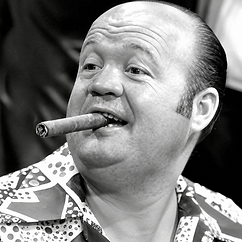
Puggy Pearson: 1973 WSOP Main Event Champion and Poker Hall of Famer

POKER HALL OF FAME
Inducted 1987
Walter “Puggy” Pearson was a four-time World Series of Poker bracelet winner, the 1973 WSOP Main Event champion and a member of the Poker Hall of Fame. One of the seven players who participated in the inaugural World Series of Poker in 1970, Pearson belonged to the small group of gamblers who helped shape tournament poker during its formative years.
His importance extends beyond his championship record. Pearson is widely credited with proposing the freezeout concept that became the foundation of modern poker tournaments, where players begin with a fixed amount of chips and continue until one competitor has accumulated them all.
Pearson also produced one of the dominant performances of the WSOP's early history. He finished runner-up in the Main Event in both 1971 and 1972 before winning the championship in 1973. That same year, he captured three WSOP events, becoming the first player to win three bracelets during a single World Series.
⠀
Who Was Puggy Pearson?
Walter Clyde “Puggy” Pearson was an American professional poker player and gambler born January 29, 1929, in Adairville, Kentucky. He grew up primarily in Tennessee and became closely associated with the generation of traveling gamblers who competed in private games and high-stakes poker before casino tournament poker developed into a major industry.
Pearson's nickname came from a childhood accident that damaged his nose. After leaving school at a young age and working to help support his family, he developed experience hustling pool before joining the U.S. Navy. Poker became an increasingly important part of his life during his military service.
After leaving the Navy, Pearson pursued gambling professionally. His career eventually brought him into the same high-stakes poker circles as players including Doyle Brunson, Johnny Moss and Amarillo Slim.
Those players would become central figures in the earliest years of the World Series of Poker.
⠀
Puggy Pearson and the Beginning of the WSOP
Pearson was one of seven players invited to the inaugural World Series of Poker at Binion's Horseshoe in Las Vegas in 1970.
The first WSOP was fundamentally different from today's tournament. The participants played cash poker, and Johnny Moss was ultimately selected as champion through a vote among the players.
Pearson's influence became particularly important as organizers looked for a better way to determine a champion. The World Series of Poker credits Pearson with developing the idea of a freezeout tournament.
Under the basic freezeout concept, every entrant receives a fixed starting stack and cannot simply buy more chips after losing them. Players are eliminated as their chips disappear, and competition continues until one player controls all the chips.
Variations involving re-entry and multiple starting flights are now common, but the freezeout remains one of tournament poker's fundamental formats. Pearson's association with that development gives his career significance beyond the results recorded beside his name.
⠀
Puggy Pearson's First WSOP Bracelet
Pearson's first WSOP title came during the second World Series in 1971.
The current WSOP historical schedule lists Pearson as the winner of the $1,000 Limit Seven Card Stud event. That victory began a four-bracelet career and established him as one of the leading competitors of the WSOP's earliest period.
Pearson also came close to winning poker's world championship that year.
He finished runner-up to Johnny Moss in the 1971 Main Event, which had six entrants. Pearson returned to the championship in 1972 and again finished second, this time behind Amarillo Slim.
Two consecutive runner-up finishes placed Pearson on the verge of the title before his breakthrough finally arrived.
⠀
Puggy Pearson's 1973 WSOP Main Event Victory
The 1973 World Series of Poker became the defining tournament series of Pearson's career.
Pearson began the series by winning the $4,000 Limit Seven Card Stud event. The official WSOP results list eight entries and a $28,000 first-place payout.
He later won the $1,000 No-Limit Hold'em event, defeating a field of 17 entries for $17,000.
Pearson then entered the $10,000 Main Event after having finished second in each of the previous two years.
Thirteen players competed for the world championship. Pearson reached heads-up play against Johnny Moss, the same player who had defeated him for the 1971 championship.
This time Pearson won.
He defeated Moss to capture the 1973 WSOP Main Event and its $130,000 winner-take-all prize. The victory gave Pearson three tournament wins during the same World Series.
According to WSOP historical records, Pearson became the first player to win three bracelets at a single WSOP. Other players later matched the accomplishment, but Pearson established the benchmark during an era when the entire series consisted of only seven events.
⠀
How Many WSOP Bracelets Did Puggy Pearson Win?
Pearson won four World Series of Poker bracelets during his career.
His bracelet victories came in:
1971 $1,000 Limit Seven Card Stud
1973 $4,000 Limit Seven Card Stud
1973 $1,000 No-Limit Hold'em
1973 $10,000 No-Limit Hold'em Main Event
As of September 3, 2026, the WSOP player database lists Pearson with four bracelets, 12 WSOP cashes, nine final tables and $265,580 in recorded WSOP earnings. The WSOP lists no Circuit rings for Pearson.
His bracelet total does not fully describe his position in early WSOP history. Three of the four came during his extraordinary 1973 series, while his consecutive Main Event runner-up finishes in 1971 and 1972 gave him three straight top-two championship finishes.
⠀
Puggy Pearson's Tournament Earnings
Historical tournament databases contain only a portion of the money that players from Pearson's generation won and lost because much of their poker activity took place in cash games rather than formally recorded tournaments.
As of September 3, 2026, The Hendon Mob lists Pearson with $473,680 in recorded live tournament earnings.
His largest recorded tournament cash is the $130,000 prize from his 1973 WSOP Main Event victory.
Those figures should be viewed as a record of documented tournament results rather than a measurement of Pearson's lifetime poker income. Pearson spent decades competing in cash games, including high-stakes games that fall outside modern tournament databases.
⠀
Puggy Pearson's Playing Style and Reputation
Pearson built his reputation as an all-around gambler rather than a player associated only with no-limit hold'em.
Seven-card stud was particularly important to his tournament record. Two of his four WSOP victories came in the game, while his other two bracelets were earned in no-limit hold'em.
Historical WSOP material describes Pearson as an accomplished seven-card stud player with an aggressive playing style. His willingness to compete across different games and stakes also reflected the environment in which his poker career developed, when elite professional gamblers were generally expected to be comfortable in multiple forms of poker.
Pearson became known for his colorful personality as well as his willingness to gamble. His public image fit the road-gambler culture surrounding the early WSOP, a period when professional poker was driven less by specialized tournament schedules and more by players traveling in search of profitable games.
⠀
Puggy Pearson and the Freezeout Tournament
Pearson's most enduring contribution may be the tournament structure associated with his name.
PokerNews, WSOP historical material and other accounts of early poker history credit Pearson with developing or proposing the freezeout concept before it became established at the World Series.
The idea solved a basic competitive problem. Instead of allowing players to enter and leave a cash game while continually purchasing chips, a freezeout gave every entrant a defined starting position and produced one eventual winner through elimination.
That structure helped make poker suitable for championship competition.
Modern tournaments have expanded far beyond the earliest freezeouts. Re-entry tournaments, bounty events, satellites and multi-flight competitions all modify the basic structure in different ways. But the principle of converting poker from an open-ended cash game into an organized competition with a defined winner remains fundamental to tournament poker.
Pearson's role in that development gives him a lasting place in poker history even apart from his four bracelets and world championship.
⠀
Poker Hall of Fame
Pearson was inducted into the Poker Hall of Fame in 1987.
His induction recognized a career that combined tournament accomplishments, high-stakes play and influence on the development of organized poker.
The Poker Hall of Fame's official WSOP directory continues to list Walter Clyde “Puggy” Pearson among its members.
His Hall of Fame legacy is closely connected to the earliest generation of the World Series. Pearson participated in the inaugural gathering, helped shape the type of tournament that the WSOP would eventually adopt and became one of its first dominant champions.
⠀
Puggy Pearson's Later Years and Death
Pearson remained closely associated with poker long after his championship years.
His final recorded WSOP result in the current WSOP database came in the 1989 Main Event, although he continued appearing around the World Series and remained a recognizable figure within the poker community for years afterward.
Pearson died in Las Vegas on April 12, 2006, at age 77.
His death came only a few years after poker's early-2000s expansion had transformed the World Series from the small gathering Pearson knew at its beginning into an international tournament festival attracting thousands of players.
Pearson had been present at the foundation of that transformation. From the seven-player gathering in 1970 to the modern freezeout tournament structure, several important pieces of WSOP history intersect with his career.
⠀
Puggy Pearson's Poker Legacy
Puggy Pearson's place in poker history rests on several separate accomplishments.
He was the 1973 world champion, a four-time WSOP bracelet winner and a Poker Hall of Fame member. He reached the Main Event's final heads-up confrontation three consecutive years, finishing second twice before winning. He became the first player to capture three bracelets during one World Series.
His influence also reaches beyond tournament results.
Pearson was part of the original 1970 WSOP lineup and is credited with helping develop the freezeout format that became a foundation of tournament poker. That connection places him not only among the champions of the WSOP's earliest era, but among the players who helped determine what a poker tournament would become.
Decades after his final competitive results, the structure he advocated remains central to the game.
⠀
Frequently Asked Questions
Who was Puggy Pearson?
Walter Clyde “Puggy” Pearson was an American professional poker player, high-stakes gambler, four-time WSOP bracelet winner and the 1973 World Series of Poker Main Event champion. He was inducted into the Poker Hall of Fame in 1987.
⠀
How many WSOP bracelets did Puggy Pearson win?
Puggy Pearson won four WSOP bracelets. His first came in 1971, and he won three more during the 1973 World Series of Poker.
⠀
Did Puggy Pearson win the WSOP Main Event?
Yes. Pearson won the 1973 WSOP Main Event after finishing runner-up in both 1971 and 1972. He defeated Johnny Moss heads-up and earned the $130,000 winner-take-all prize.
⠀
How much did Puggy Pearson earn in live poker tournaments?
As of September 3, 2026, The Hendon Mob lists Pearson with $473,680 in recorded live tournament earnings. His largest recorded cash was the $130,000 prize for winning the 1973 WSOP Main Event.
⠀
Did Puggy Pearson invent the freezeout poker tournament?
Pearson is widely credited with developing or proposing the freezeout concept that became a foundation of modern tournament poker. The structure gives players a fixed amount of tournament chips and eliminates them when those chips are lost until one winner remains.
⠀
Is Puggy Pearson in the Poker Hall of Fame?
Yes. Walter Clyde “Puggy” Pearson was inducted into the Poker Hall of Fame in 1987.
⠀
When did Puggy Pearson die?
Pearson died in Las Vegas on April 12, 2006. He was 77 years old.
⠀
Why is Puggy Pearson important to poker history?
Pearson was one of the seven players at the inaugural 1970 World Series of Poker, won four bracelets and the 1973 Main Event, became the first player to win three bracelets during a single WSOP and is credited with helping develop the freezeout tournament format.